
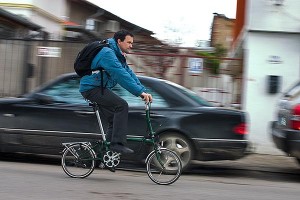
 The best way to get round Bucharest is by bike. Bucharest has no ring roads and the result is gridlock. Getting anywhere by car is slow and frustrating. Public transport is good but very overcrowded.
Non cyclists tell me that cycling in Bucharest is dangerous, that Romanian drivers are crazy and that there are no proper bike lanes. But even the most insane speed freaks can’t do much in Bucharest where traffic moves at a snails pace (but watch out for the sons of the Nomenklatura who come out at night to race on the Boulevards). And if you keep your ears open you can hear the motorbikes and Kamikaze BMW drivers from miles away. (more…)
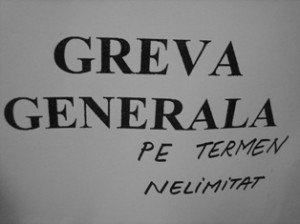 Something strange happened to me last week. I was at the recycling bins with my 7 year old son Luca (who likes to practice karate chops on chunks of polystyrene) when a garbage truck pulled over. Two fat guys got out, wandered over and helped us to load our Ikea waste into the containers. I couldn’t understand it, what on earth had got into them? I’m used to garbage men being morose and sarcastic, reluctantly moving the waste they’re hired to shift but never lifting a finger to do more. Why were they suddenly being helpful? Could it be because of the crisis? Are they afraid for their jobs?
  When discussions about promoting Serbia take place the following comment often comes up: “shouldn’t we develop a country brand?” The short answer is “NO”. I am from Scotland, I now live in Romania, and I would like to share my opinion of branding countries. I hope that Serbia can learn from the mistakes of others.
 I was asked to write an article for Dilema Veche on the theme “what can we expect in 2010?” and this is what I think. But what do you think? Please leave your comments below. Rupert Wolfe Murray
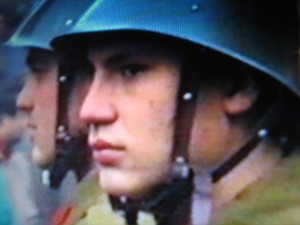 I am making a documentary film about the events that took place in January 1990, using an extraordinary archive of material that was filmed by Laurentiu Calciu, who got a video camera just after the revolution. We have some fascinating material of ordinary people on the streets furiously debating about all things political, social and economic. The material is filmed with a patience that gives an insight into what people were thinking just after Ceausescu fell.
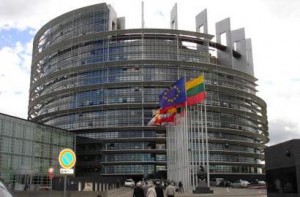 This article was also published in the
 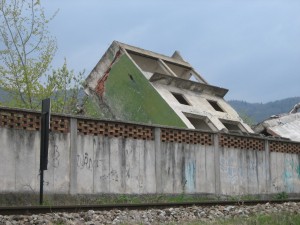 Preparing for disasters is an industry and also an attitude. There are lots of professionals flying around the world advising governments how to prepare for earthquakes, floods and natural disasters; thousands of humanitarian aid agencies rush in when disaster strikes and there are public officials everywhere whose job is to prepare the public for the worst — not to mention firemen, policemen, medical workers and soldiers who invariably form the front line of any disaster relief efforts. I have some experience of this profession.
  I got ridden to Laurentiu’s house in the dark on a road through the centre of Bucharest, a road that is usually crowded but at that moment was deserted because it was the middle of the night; Laurentiu appeared in his pajamas and handed over a disk, a memory stick, said farewell and we were off — but only for a bit as time was pressing and I got folded up and put in the back of a taxi as my Master feared we wouldn’t make it on time, and his fears were probably justified as it is rather a long way to the airport.
 Last Christmas I bought myself an 80 megabyte iPod. This was a bit of a cheat considering it cost more than the presents I got for my loved ones, but I bought it through the company and justified it that way. Although iPods look amazing they are a pain in the butt because in order to use them you must download iTunes, Apple’s software, and this takes up 80 megabytes. And iTunes has its own way of organising your music, which I have still failed to understand, and this bugs me as I spent a long time thinking up a good filing system for my music.